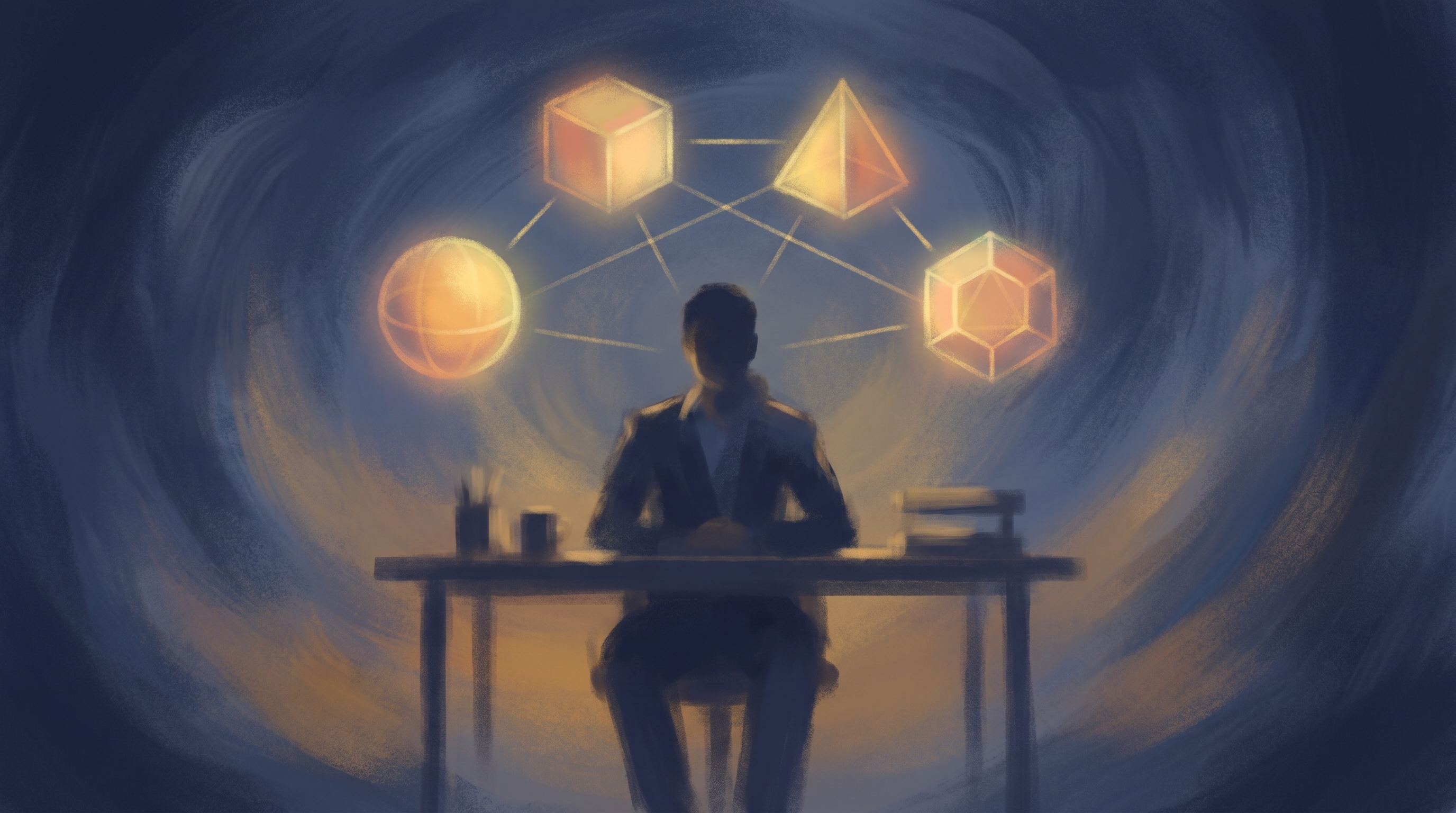
Burnout doesn't just drain your energy. It distorts your judgment.
The urge to quit everything — change industries, move cities, start over from scratch — is loudest when your reserves are lowest. That's not a coincidence. When you're depleted, your brain shortcuts to escape instead of evaluation.
And the advice you get from the people who care about you? It's the worst kind. Your partner wants stability. Your friends reflect your frustration back at you. Your manager wants you to stay. Every person with something useful to say has skin in the game.
According to a Deloitte survey, 77% of workers have experienced burnout at their current job. According to the Upwork Research Institute, 71% of full-time employees feel burned out right now. The WHO has classified burnout as an occupational phenomenon — not a personal failing, but a systemic signal.
Here's the part nobody talks about: burnout doesn't tell you what to do next. It just tells you something has to change.
That's the gap an AI mentor can fill. Not the wellness app that tracks your heart rate. Not the journaling tool that asks how you're feeling. A mentor grounded in what founders, executives, and people who've navigated their own versions of this have actually published — with no agenda about what you should do.
Here are four conversations worth having before you make any major move.
Conversation 1: Is It the Work, the Environment, or Me?
Most burnout diagnoses stop at "I'm exhausted." That's the symptom. The source is what matters.
There are three distinct types. Content burnout — you've mastered this work and it no longer challenges you. Structural burnout — the organization is broken: the workload is unsustainable, the culture is toxic, or there's no path forward. And identity burnout — you've grown out of the version of yourself who wanted this job.
Each one has a completely different fix. Content burnout means you need new challenges, not a new company. Structural burnout means the company needs to change — or you need to leave it. Identity burnout means the job was never the real problem.
An AI mentor grounded in the published frameworks of people who've navigated all three types can help you figure out which one you're actually in. Not by guessing — by asking the right questions.
Open the app. Ask: "I feel burned out. Help me figure out whether this is about the work itself, the environment I'm in, or who I've become since I took this job."
Conversation 2: What Would I Actually Miss?
When you're depleted, everything feels terrible. That's not a useful data point.
The better question: strip away the frustration, the exhaustion, the bad weeks — what would you lose if you left tomorrow? The craft? The team? The specific problem you're solving? The income? The identity the role gives you?
Most people can't answer this clearly because they're still inside the frustration. A good mentor creates distance. They ask you to describe the best week you had in this role in the last year. What made it good? Was that week possible because of the job — or despite it?
This conversation doesn't tell you whether to leave. It tells you what you're actually optimizing for. And that matters whether you stay or go.
Conversation 3: What Would You Do If Staying Wasn't an Option?
Constraints clarify.
When the option to stay is on the table, your brain protects you from the discomfort of actually choosing. "I could stay" keeps you from answering "what do I want?"
An AI mentor can run this as a structured thought experiment. Imagine your company announced layoffs and your role was eliminated. What's your first call? Not the panicked call — the one after the panic settles. Who would you call? What would you say you want to do next?
The answer you give when the comfort option is gone is usually closer to what you actually want than anything you say while it still exists.
According to Qooper's 2025 research, structured AI-enhanced mentoring increases career program success rates by 30%. The structure is the point. Unstructured rumination produces the same thoughts in loops. A mentor-guided conversation breaks the loop.
Conversation 4: Am I Running Away or Moving Toward Something?
This question shows up in almost every burnout story — usually after someone has already quit.
Running away and moving toward feel identical when you're depleted. They're not. Running away solves the immediate pain without addressing the underlying source. Moving toward something produces decisions that hold up after the adrenaline of leaving fades.
An AI mentor can help you build the "toward" version — not in the abstract, but specifically. What role? What kind of work, at what pace, for what kind of outcome? Not a dream. A direction.
Then test it. Get Mentors lets you put one question to your whole board of mentors and see where they agree — and where they pull in different directions. Burn out makes us want simple answers. Multiple perspectives are the antidote.
MentorcliQ research shows that employees with mentors are 5x more likely to be promoted. But the less-cited finding: mentored employees report higher job satisfaction and lower turnover. They make better decisions about where to direct their effort — before they're depleted.
How Get Mentors Approaches This
The conversations above aren't therapy. They're decision-making under stress.
Get Mentors is built for exactly this. You keep a board of five mentors, chosen from 441, and you can ask any one of them directly how they'd approach a hard decision — every answer grounded in what that specific person has published, not generic wellness prompts. Or put one question to the whole board and see where the positions converge and where they split — each marked agrees, partly, or disagrees, and each citing the book, letter, talk, or interview it came from.
Burnout is when you most need access to perspective you can trust — and least have access to it in your network. That's the gap.
FAQ
Q: Can an AI mentor app actually help with burnout? A: Not as a mental health intervention — that's what therapists are for. But as a decision-making tool during burnout, yes. Burnout produces specific thinking traps: escape thinking, black-and-white framing, catastrophizing. A structured conversation with an AI mentor grounded in real advisors' published work helps you test your thinking and separate signal from noise before you act on it.
Q: Should I make career decisions while burned out? A: The decision may be unavoidable. But you can improve the quality of it. The four conversations above don't require you to be fully recovered — they're designed to work with where you are right now. The goal is clarity about what kind of change you actually need, not just "I need to leave."
Q: What's the difference between an AI mentor app and a wellness app for burnout? A: Wellness apps (journaling, mood tracking, breathing exercises) address the symptoms of burnout. An AI mentor app addresses the decisions that burnout forces. Both have value. But if you're trying to figure out what to do next — not just feel better in the moment — a mentor conversation is the more useful tool.
Q: How do I start this kind of conversation in a mentor app? A: Be direct about where you are. Try: "I've been burned out for three months and I don't know if I should stay or leave. Help me think through what this is actually telling me." A good AI mentor — grounded in what real advisors have published — will ask the right follow-up questions rather than hand you a list.
Ask a board of people like these.
Pick 3 to 5 people from about 195, including Naval Ravikant, Alex Hormozi, and Mark Cuban. Ask about a decision and see what each has said about it, with sources. Your first 5 questions are free. iPhone.